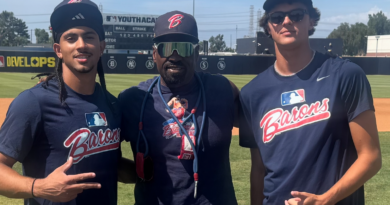

Compton Wrestler Joey “BLACK ICE” Davis Inducted into the California Wrestling Hall of Fame..
By Joey Krebs

“I never knew or saw wrestling as a sport, because it never was mine. But that didn’t stop me from stepping on the mat because I was born to be a fighter, because it’s where I belonged.” —
Joey “Black Ice” Davis
On a cool, mild spring evening in the affluent and wealthy bedroom community of Laguna Hills, California, a room full of championship athletes, coaches, and legendary wrestlers gathered to celebrate the pinnacle of historical excellence in one of America’s most talented states. Each year, its prestigious community selects the very best inductees from decades of worthy recipients. Among the names honored at this year’s 2025 California Wrestling Hall of Fame banquet, one name stood out—not only for his undefeated record, but for the unlikely journey of hardship that he alone took to reach the podium.

Joey “Black Ice” Davis Jr. was born on December 29, 1993, in Compton, a city without a feeder or wrestling program, and rose to become one of the most dominant forces in the sport. He was an anomaly—the kid who was mocked and ridiculed for wearing wrestling singlets and tights, because the sport of wrestling was not spoken of in his hood.

On Saturday, May 17th, 2025, the California Wrestling Hall of Fame finally gave Little Joey the recognition that he so justly deserved. But this is not just a story of accomplished trophies, hardware, medals, and accolades, it is the narrative of a young Black man who courageously dared to dream of greatness, despite being oppressed a survivor, of racial discrimination, surviving segregation, and systemic inequities, This is a lesson of one Black man’s relentless pursuit of greatness, swimming upstream against the undercurrents of systemic discrimination, marginalization, exclusion and racism.


Little Joey could have been a statistic like many of his friends with whom he grew up. Still, instead, he was an anomaly, a wrestler who learned early how to duck-under drive-by shootings between Crips and Bloods, being able to withstand the gut-wrenching family evictions and addictions, homelessness, systemic intolerance in a sport that was never kind.
As a kid on the streets of Compton, Joey Davis learned early not to be pinned in his fight game to ‘protect himself at all times,’ practicing his footwork while walking home on Compton’s streets, outmaneuvering, and battling its streets like it was a formidable foe. For Little Joey, no Green Book* manual would ever provide him with respite or navigation to his destined path to NCAA glory. Little Joey had to drive and model his own ride, a vehicle he called his black paradigm.

But in spite of it all, Little Joey was surrounded by love and was introduced to the sport of wrestling by his loving and supportive father, a former Cerritos JC Wrestler whose family traveled west from Gary, Indiana, to California in search of a better life and opportunity. Joey was literally raised by his community, where the tiny five-year-old Black child was selectively hand-picked to be coached by Antonio ‘Tone’ McKee, one of the greatest combat arts practitioners, whose fundamental fighting form was rooted in wrestling. McKee was also renowned for producing champions like his son AJ McKee who grew up wrestling with Little Joey, Tone is also known for not withholding punches, So it came as no surprise that Coach Tone was also marginalized as a Black renegade fighter in the fight world, because of being outspoken against the combative arts most coveted fight promoters and powers that be, Yet to his fighters Tone was a mentor, a beacon of Black excellence and most of all to Little Joey.
By the time Davis entered Santa Fe High School, his raw athleticism had already matured and blossomed into something special, a talent that comes every thousand years. A CIF state champion finalist in his sophomore year, a champion in his junior and senior years, he didn’t just beat his opponents—he dismantled expectations. But his decision to forgo football for wrestling was a turning point. He chose a path where Black faces were rare, and Black champions even rarer. And he walked with defiance..
And yet, wrestling’s gatekeepers have long sought to erase or marginalize the contributions and experiences of its black histories, with its implementation of the “Carlton Haselrig Rule”—which banned D2/D3 and NAIA basement wrestlers ( Baseball Negro Leagues) like Joey Black Ice Davis from ever competing in Division I NCAA Wrestling Championships—

The story of Division II and III NAIA Championship wrestlers who, at one time, could qualify for the Division I NCAA Wrestling Championships is the story that is ‘buried down in its memory hole’ of history. Today, like yesterday, and like tomorrow, NCAA D2, D3, and NAIA wrestlers will be forever denied access to the main Championship D1 stage. Even the title 9 NCAA Women’s Wrestlers will not deny their wrestlers, but these fighters from the basement leagues were never denied the will to fight. These countless athletes are not misnomers, but are legitimate and credible warriors, whether or not they play in the basement leagues. They are jewels in the rough, living proof that institutional prestige does not equal individual power or talent.

Joey Davis Jr. is the only NCAA Division II wrestler in its history to finish his career undefeated and uncontested, with a record of 133 wins, zero losses, and zero forgiveness from the institution that once profiled him instead of protecting him. Joey’s record, STANDS, immortalized in the California Wrestling Hall of Fame, stands as a monument not just to greatness but to survival. When asked what his greatest move was. He answered through literary tact and poetic metaphor; it was the Stand-Up, which is a technique for escaping from a difficult position. But for Joey, the stand-up was more than a wrestling move—it was a belief, a state of mind, a monumental rights practice sourced in the civil community, becoming his signature move. This move not only embellished his wrestling identity but also enriched his intellectual repertoire. The Stand Up taught Little Joey how to survive the ghetto with resiliency in the face of systemic oppression.
For his induction is as much a personal milestone as it is a symbol of reclamation. It honors a young black man from Compton who has not only excelled but also endured and dared to stand up. In a sport that often speaks the language of humility and hard work while ignoring the racial and cultural barriers within its own ranks, Davis is a walking contradiction: Black and Proud, undefeated, and unbroken.
In reflection, Joey Davis Jr never claimed credit by himself at the California Hall of Fame Induction Banquet and in the tradition of the Black community that raised him, the altruistic and benevolent wrestler and fighter acknowledged those who have inspired and mentored him, protected him, and those who believed in him, when its community could not or would not.
Black Wrestling Lives Mattered…
Little Joey credited mentors like Rampage Jackson, Louis Bland, Jim Brown, Antonio McKee, and JD Hawkins. Their names, like his, are not token figures in a Jack’d Box of diversity. These names are pillars of countless forgotten narratives, where systemic practice sought to erase the Black race. Need Proof? The release of Foxcatcher includes an important, arched final scene where Olympic Gold medalist Mark Schultz is shown competing in the UFC, where he fights a white opponent. In reality, Mark Schultz did fight Gary “Big Daddy” Goodridge, a black fighter, at UFC 9 in 1996.
Goodridge’s portrayal in the movie is an inaccuracy and an error through the act of “whitewashing,” where its directors and producers went out of their way to cast a white actor in roles meant for people of color, erasing its black minority characters and burying their narrative. In this intentionally egregious act, the film alters the opponent’s race in the UFC scene; Goodridge’s existence, along with his identity as a Black athlete in the real historical context, is erased. The real Mark Schultz did fight and defeat Gary Goodridge at UFC 9. But in its film, the actual scene was never accurately and historically depicted.
In closing, as an allegory, the BLACK ICE story is a cautionary tale for future young black athletes, with its lesson and allegory that winning is never just about the victor, but rather about learning how to fight for one’s cause. Like a Black existentialist, Joey’s acceptance speech was best expressed by the lessons authored by a sport that teaches: success will never come to those who wait, for waiting is the prerogative of power.
Like a wise man, Davis summarized that victory, personified, reveals that as a combatant of the art who represents the diverse community, you may never be invited to its banqueted feast. For dreams never come to those who hesitate, who overthink, or who believe they have the luxury of waiting for motivation. For victory in the great combative arts is always defined by those who courageously dared to act.
In celebrating Joey Davis Jr., the California Hall of Fame did more than honor a Champion. It recognized the community that supported him and the fire that was forged in him. And now, as his legacy continues in the cage, in the community, and in the consciousness of a new generation of Black athletes, one thing is clear:
Joey “Black Ice” Davis Jr never asked for permission to be a fighter.
He took the mat—the cage by storm—and never gave it up.