
The Honorable Stacey Abrams Sets the Bar for the Work of Democracy in Los Angeles
By Dr. Marie Y. Lemelle, MBA, PhD
Special thanks to City Pride Magazine
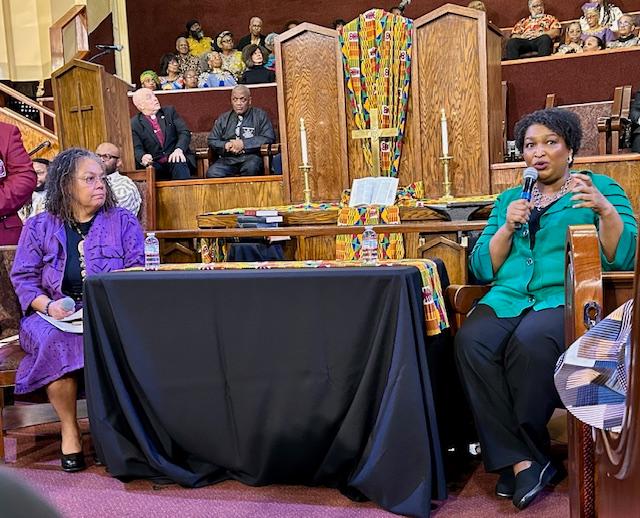
Honorable Stacey Abrams to continue her message to Los Angeles and to respond to
audience questions. Photo: Platinum Star Public Relations
On Sunday, February 1, 2026, I witnessed something rare and necessary inside FAME Church in Los Angeles. What unfolded during the Founder’s Day Worship Service was civic clarity shaped by faith, history, and responsibility.
History maker, the Honorable Stacey Abrams, arrived with an assignment for the City of
Los Angeles. As the first woman to lead either party in the Georgia General Assembly and the first African American to serve as House Minority Leader, Abrams earned our attention. In 2013, she founded The New Georgia Project, a nonprofit that expanded voter registration by approximately 86,000 new voters, demonstrating what intentional leadership and organized civic engagement can achieve. Her accomplishments and record set a standard we are called to pursue.
Before Abrams ever reached the podium, the moment was anchored by Jacquelyn
DuPont-Walker, widely known as Jackie. For more than 35 years, she has served South
Los Angeles as the founding president of the Ward Economic Development Corporation,
while also carrying leadership roles as AME Church International Social Action Officer,
President of the Lafayette Square Association, Social Action Chair of Delta Sigma Theta
Sorority (Century City), and across a host of civic organizations.
She did not offer comfort. She offered a charge.
She reminded the congregation that while silence might be easier in moments like this,
fruit is not produced in silence. Movements, she said, rise when faith rises. Not passive
faith, but a faith that confronts injustice, proclaims hope, and sits in God’s spaces with
the oppressed.

She spoke of equipping leaders and welcoming those who never imagined themselves
called. Of clergy renewed and informed, resolved to lead congregations beyond
sanctuaries and into streets, courtrooms, classrooms, and halls of power.
“This is not a ceremonial moment,” DuPont-Walker told the congregation. “This is a
commissioning moment. What we do after today in advocacy, education, organizing, and
service is the truest measure of our rising. Voices are being silenced. Rights are being
restricted. History is being rewritten. This occasion declares we are still here. We are still
faithful. We are still blessed. It is our watch. It is our time.”
Then Rev. Dr. Mark K. Tyler, senior pastor of Mother Bethel African Methodist Episcopal
Church in Philadelphia, stepped forward and reminded us that none of this is new. The
American story and the Black church story have always run side by side, often in
tension, often in resistance.
As the nation prepares to mark its 250th anniversary, Tyler reminded the congregation
that in 1777, just one year after the Declaration of Independence was signed, Richard
Allen, born free in Philadelphia and enslaved in Delaware, encountered abolitionist
preaching that transformed his understanding of faith and freedom. That seed, planted
amid contradiction and bondage, would grow into the African Methodist Episcopal
Church.

Tyler traced the painful irony of 1787, when the U.S. Constitution was finalized just
blocks away from Black worshippers being forced out of segregated churches. He spoke
of Selma in 1965 and how the Civil Rights Movement might not have unfolded as we
know it without the courage of churches that opened their doors when it was illegal to
organize, when pastors risked jail and faced firebombs simply to create a meeting
space.
“The church has always been the conscience of this nation,” said Tyler, an active
member of Alpha Phi Alpha Fraternity, Inc. “And every time democracy has been
threatened, it has been the church that carved out space for resistance, organization,
and hope.
The AME Church has 2.5 million members across 40 countries on five continents.
From there, Los Angeles-born and Bay Area-raised Bishop Francine A. Brookins, Esq., a
distinguished leader and the 141st bishop of the AME Church, is the fifth woman to
achieve this esteemed position. She stands on the shoulders of her parents, Rev. Carole
Nelson Ingram and the late Bishop Hamel Hartford Brookins, a renowned civil and
human rights advocate.
Brookins introduced the keynote speaker with reverence and resolve, describing Abrams
as a force of nature. A visionary leader. A best-selling author. A fierce advocate for
democracy. A proud daughter of the Deep South.
Brookins reflected on Abrams’ journey from high school valedictorian to Yale-trained
attorney and historic trailblazer in Georgia politics. She emphasized that Abrams’ life
stands as a testament to what is possible when God and God-trained creative flesh unite
in understanding their assignment.
It was within that lineage that Abrams spoke.
“I have spent more than forty years of my life thinking about and working toward the
democracy I believe in,” Abrams said. “Not because I believe in the construct itself, but
because I believe poverty is immoral. It is morally inefficient. It is economically inefficient.
And it is solvable. Democracy is how we solve it.”
She did not frame democracy as a partisan construct, but as a moral obligation. Too
often, she said, we reduce democracy to a single day. Election Day. If we win, we relax.
If we lose, we retreat. But democracy does not live on the day we cast a ballot.
Democracy, Abrams reminded us, lives in the days between. It lives in organizing,
mobilizing, protecting one another, and telling the truth when silence feels safer.

What followed was not rhetoric. It was instruction.
Abrams laid out, in totality and with precision, the ten steps authoritarian systems use to
dismantle democracy, not as a warning about the future, but as a description of the
present.
First comes the last free and fair election, which must be remembered because it
may be the last one that truly functions.
Second is the expansion of executive authority, where executive orders, pardons,
and unilateral decisions replace the democratic process.
Third is the weakening of competing powers, as legislatures and courts are
stripped of meaningful oversight and enforcement.
Fourth is the intentional breakdown of the government so it no longer serves the
people. When institutions fail, trust collapses.
Fifth is the installation of loyalists, not to the Constitution or the public, but to
power itself.
Sixth is the attack on truth, including journalists, educators, artists, and public
broadcasters, followed by the replacement of truth with propaganda.
Seventh is the scapegoating of marginalized communities, turning immigrants,
LGBTQ+ people, people of color, and the poor into convenient targets.
Eighth is the weakening of support systems, including churches, universities,
nonprofits, and philanthropy, which leaves communities isolated and fearful.
Ninth is the normalization of state violence, where militarized enforcement
becomes routine, and silence feels safer than resistance.
Tenth is the destruction of public faith in democracy itself, leading people to
believe that participation no longer matters.
“You don’t have to cancel elections to destroy democracy,” Abrams said. “You only have
to convince people that showing up no longer matters.”
Abrams then turned the framework on its head.
If democracy can be dismantled in steps, it can also be rebuilt in steps.
- We must know where we are and name the moment honestly.
- We must tell the truth, even when it is uncomfortable.
- We must organize, because democracy is collective work.
- We must mobilize, especially in hard and hostile spaces.
- We must litigate and advocate, using law and voice together.
- We must disrupt, refusing comfort over justice.
- We must engage power or become it ourselves.
- We must elect, treating elections as a beginning, not the end.
- We must rebuild belief in institutions and in one another.
- We must demand the nation we deserve.
One metaphor anchored the message. “It is not the water in the washing machine that
cleans the clothes. It is not the soap,” said the Civil Rights Leader and Military Veteran
Hosea Williams. “It is the agitator.”
Abrams said the metaphor reminds us that progress has never come from comfort. It
comes from movement.
Among many accolades and accomplishments, Williams was a member of Dr. Martin
Luther King Jr.’s inner circle, a civil rights activist, and a Nobel Peace Prize winner. He
founded one of the largest social services organizations in North America, Hosea Feed
the Hungry and Homeless.
Abrams reminded the congregation that diversity, equity, and inclusion are not abstract
ideas, but the living framework of American progress, from the Reconstruction
Amendments to the Fair Labor Standards Act, the Family and Medical Leave Act, and
the Americans with Disabilities Act. These policies worked precisely because they
expanded access and opportunity, which is why they are now under attack.
She closed with a memory from her childhood in Mississippi.
Her father worked long hours in a shipyard. They had one car. One winter night, during a
cold, relentless storm, his usual ride was unavailable, so he had to walk 40 miles. Along
the way, he gave his coat to a stranger he saw shivering along the highway.
Each member of their family owned only one coat. You didn’t give up your coat.
Abrams’ father would check in with his wife from payphones while enroute. When her
mother didn’t hear from her father, she gathered her children and drove along the road
until they found him, wet and cold, and asked where his coat was. He explained his
choice.
Abrams and her sister braced themselves, expecting a scolding. It never came. Instead,
their mother turned up the heat, said nothing, and drove them home.
Abrams said she and her sister later realized they had witnessed a miracle. Not only
because their father was safe, but because their mother recognized the moral clarity of
his decision and honored it.
“He gave away his coat because he knew we were coming for him and the [coatless]
man on the road would still be there waiting when they were long gone,” Abrams said.
“That is how we come for democracy. We do the work because we know someone is
coming for us. And because we are willing to come for each other.”
That story captured the spirit of the day.
Because the community will meet us on the road. Because faith, when activated,
becomes action. And because democracy survives only when we decide it is worth the effort.

Marie Y. Lemelle, MBA, PhD, is the Beverly Hills Chapter of the
Southern California Black Chamber of Commerce, a humanitarian,
thought leader coach, founder of Platinum Star Public Relations, and
member of the LA Press Club. @platinumstarpr