Inside the 27th Annual Golden Eagle Film Festival: Cal State LA Students Learn What It Takes to Build a Career in Entertainment
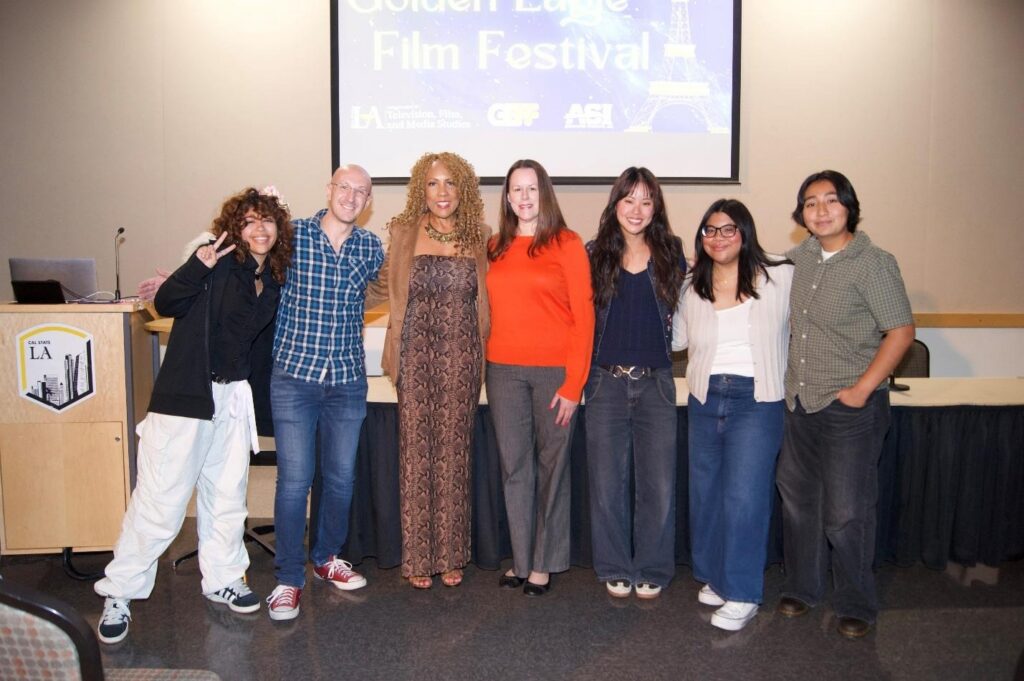
Dr. Marie Y. Lemelle, Laura Pursley, and Sophia Chew, along with students Daniza Guevarra,
and Panel Moderator Jackie Zamora. Photo credit: Debra Hurst
From film publicity and crisis management to social media strategy and audience targeting, industry professionals offered students practical insight into navigating today’s entertainment business.
The 27th Annual Golden Eagle Film Festival at California State University, Los Angeles, featured a “Marketing in Entertainment” panel that gave student filmmakers a practical look at how films build audiences and how entertainment careers take shape. The panel, moderated by student Jackie Zamora, brought together professionals from film, publicity, cinematography, production, and entertainment marketing. Students asked questions about social media, audience development, branding, publicity, and breaking into the industry.
Commercial and narrative director Sam Felman encouraged students to look for real needs in the marketplace. “Look for the pain points of your business,” Felman told students. “Look for where’s the gap that you can fill, and then double down on it.” Felman said the Cal State LA students showed a strong grasp of how marketing affects careers. “Nobody’s talking about how smart these kids are,” he said. “Speaking on the marketing panel at the Golden Eagle Film Festival showed me how eager the film students are to do the work and start their careers.”
He added, “When I was in school, none of my classmates cared about marketing. But without it, nobody will know how great your film is or help you start your career. These students get it.”
Laura Pursley, founder of Purrmark Consulting and a former Warner Bros. marketing executive, discussed audience targeting and studio campaign strategy. “In the case of Harry Potter, it was kids six to 11,” Pursley said. “The secondary audience was parents of kids six to 11.”
Pursley praised the students who produced the festival. “The students in the Cal State LA film program did an excellent job producing the festival,” she said. “They brought thoughtful inquiry and engaged attitudes to the panel event, exactly what we need for the future of media and entertainment.”
Dr. Marie Y. Lemelle, PhD, Ped.D, founder of Platinum Star Media Group, Inc., Platinum Star Public Relations, Inc., and Pitbull PR Agency, also served as a panelist. She has an extensive IMDb profile and experience as a talent manager, casting consultant, TV/Film producer, and entertainment publicist.
“My first introduction to this arena was as a pro boxing publicist,” Dr. Lemelle told students. “I knew about the world of boxing, but not how to effectively promote it, especially in a male-dominated sport.”
Dr. Lemelle said writing, mentorship, and relationships remain central to entertainment publicity. “Strong writing skills are your foundation,” she said. “Networking is equally important, because this industry is built on relationships with journalists, media professionals, and influencers who help move stories into the public conversation.” She also told students that film publicity should be built into a project from the beginning.
“Film PR begins the moment your project is greenlit,” Dr. Lemelle said. “Your marketing strategy should not be an afterthought. It belongs in the budget from day one as the roadmap for building anticipation, shaping audience awareness, and creating the momentum that carries a film from production to the marketplace. Your greatest assets are your cast and your story. When those are positioned with intention, you do more than promote a film. You build a following, fill seats, and give the project the strongest chance to be seen, distributed, remembered, and celebrated.”
The panel also addressed crisis management in live entertainment. In response to a
student question about how to handle a boxer failing to make weight and becoming disqualified from a scheduled boxing match, Dr. Lemelle drew from her boxing publicity
experience to explain how publicists must respond when unexpected changes affect a
live event, including canceled appearances, delayed talent, or changes to the fight card.
“Good marketing is also having a contingency plan,” she said. “It’s also having an
alternative way to explain what’s going on and let the public know as soon as possible.”
For Dr. Lemelle, returning to CSULA carried personal significance. “As a former student
of Cal State LA, it was a full circle moment to return to the campus and share
experiences that shaped my career,” she said. “It was inspiring to connect with such a
talented pool of filmmakers who have the potential to put their film program on the map
alongside other cinematic schools.”
Sophia Chew also spoke about using social media to create professional opportunities.
Chew is pursuing a degree in Film and Television Production at Chapman University,
with a concentration in cinematography and directing. “I make things to be seen,” Chew
said.
She described how a self-produced music video made with accessible equipment led to
industry attention and opportunities with a major camera brand.
The panel gave students a closer look at the work behind the visibility of entertainment,
from identifying an audience to preparing for public-facing challenges. It also
underscored the role CSULA’s film students are already playing as emerging storytellers
entering the industry.
The panelists may be reached on Instagram at Dr. Lemelle @platinumstarpr, Sam
Felman @SamFelman, Sophia Chew @shots_by_sophia, and Laura Pursley
@laurapursley.